Dangling Pose in Yin Yoga: Standing Forward Fold Guide
Dangling Pose: Overview
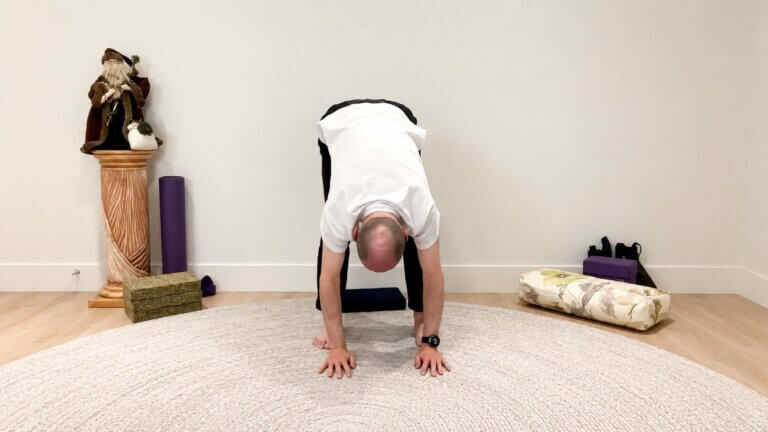
Dangling Pose is the Yin Yoga version of a standing forward fold. The knees soften, the torso folds over the legs, and the upper body hangs with as little effort as practical. Rather than trying to reach the floor or force the hamstrings, the intention is to let gravity and time encourage the lower back and back body to soften.
How to Do Dangling Pose
Stand with your feet about hip-width apart.
Bend your knees generously and fold forward.
Let the spine round and allow the head, neck, and shoulders to relax.
Hold opposite elbows, clasp the hands, let the arms hang, or place the hands on the floor if that happens naturally.
Keep enough bend in the knees that the upper body can soften.
Come out slowly, either rising gradually or moving into a squat first.
Grab opposite elbows and let gravity do the work for Dangling Pose
Benefits of Dangling Pose
Physical Benefits
Gentle spinal flexion through the lower and middle back.
A back-body stretch that may include the hamstrings, calves, glutes, and tissues along the spine.
Quadriceps work when the knees are deeply bent.
Energetic Benefits: Meridians & Energetic Effects
Within the traditional Yin Yoga and Traditional Chinese Medicine framework, Dangling is commonly associated with the Urinary Bladder meridian due to the stretch along the backs of the legs and spine. The Liver, Spleen, and Kidney meridian systems may also be discussed in relation to the Pose.
Contraindications & Safety Tips
Use caution with conditions for which head-below-heart positions have been restricted.
If you become light-headed easily, come out very slowly.
If spinal flexion aggravates your back, bend the knees more, support the torso, or choose another pose.
Stop if you experience sharp pain, electrical sensations, numbness, or anything that feels distinctly wrong.
Dangling Pose Modifications & Variations
Bend the Knees More
A deeper bend reduces the hamstring demand and can make it easier to let the torso rest toward the thighs.
Rest the Elbows on the Knees or Thighs
If hanging freely feels too strong, rest the elbows or forearms on the knees or thighs. You can also use a chair or sturdy table for additional support.
Feel too strong? Try resting on the Knees
Use Caterpillar Instead
If standing is uncomfortable or balance is a concern, try Caterpillar Pose.
Muscles, Joints & Target Areas
Hamstrings
Quadriceps
Calves
Back-body tissues
Spine in flexion
Hips and knees
Beginner Tips for Dangling Pose
Start with bent knees.
Let the head be heavy.
Keep the feet grounded.
Do not bounce.
Use support when needed.
Come out slowly.
How Long Should You Hold Dangling Pose?
For many people, one to three minutes is plenty. Because the legs still work, Dangling can become intense more quickly than a fully supported floor pose. Beginners may start with 30 to 60 seconds and build gradually.
When to Practice Dangling Pose
Dangling works well near the beginning of a Yin practice, between standing poses, as a transition into Squat Pose, or before moving to seated forward folds.
Counterposes for Dangling Pose
Useful counterposes include Squat Pose, a gentle backbend, Child’s Pose, or Sphinx Pose later in the sequence.
Related Yin Yoga Poses
Dangling Pose FAQ
Is Dangling Pose the same as a standing forward fold?
It is a standing forward fold, but the Yin Yoga intention is usually softer than a conventional Uttanasana. Bent knees, a relaxed rounded back, and less emphasis on reaching the floor are common.
Should my legs be straight in Dangling?
No. Bent knees are often preferable because they reduce hamstring tension and allow the lower back to release more easily.
Why is Dangling considered Yin if the legs are working?
Dangling is not completely passive. The legs support the body while the upper body is encouraged to relax, which is why the hold is usually shorter than fully supported floor poses.
Can I watch Bernie Clark demonstrate Dangling Pose?
Yes. Watch the dedicated Dangling Pose video on the Asana at Home YouTube channel.
Dangling Pose is uncomplicated, but that is part of its value. There is no need to chase the floor or turn the shape into a test of flexibility. Bend the legs enough to support your back, let the upper body hang, and pay attention to where the Pose is actually landing in your body.
The post Dangling Pose in Yin Yoga: Standing Forward Fold Guide Written By Kevin Parenteau appeared first on Asana at Home Online Yoga Inc..
Leave a Reply Cancel reply
Recent Comments
Archives
- September 2026
- August 2026
- July 2026
- June 2026
- May 2026
- April 2026
- March 2026
- February 2026
- January 2026
- December 2025
- November 2025
- October 2025
- September 2025
- August 2025
- July 2025
- June 2025
- May 2025
- April 2025
- March 2025
- February 2025
- January 2025
- December 2024
- November 2024
- October 2024
- September 2024
- August 2024
- July 2024
- June 2024
- May 2024
- April 2024
- March 2024
- February 2024
- January 2024
- December 2023
- November 2023
- October 2023
- September 2023
- August 2023
- July 2023
- May 2023
- March 2023
- February 2023
- August 2022
- July 2022
- June 2022
- May 2022
- April 2022
- March 2022
- February 2022
- January 2022
- December 2021
- November 2021
- October 2021
- September 2021
- August 2021
- July 2021
- June 2021
- May 2021
- April 2021
- March 2021
- April 2020
- March 2020
- February 2020
- January 2020
Theme by The WP Club . Proudly powered by WordPress