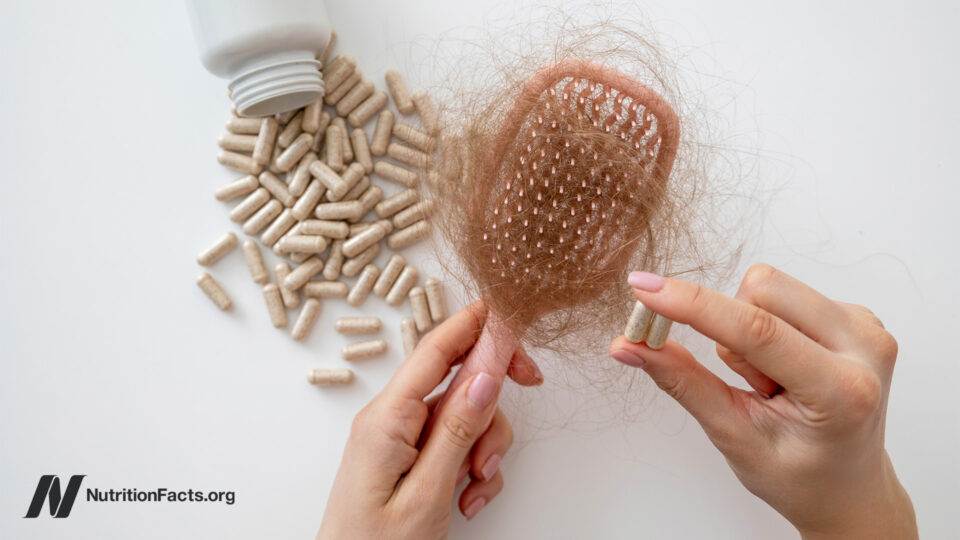
Do Hair Growth Supplements Work?
Might biotin or zinc supplements prevent hair loss in men and women?
By the time we’re 50, about half of us, men and women, will experience hair loss. No, it’s not caused by washing your hair too much or, for that matter, brushing it too much either—two of the many myths out there. Researchers found that the majority of hair loss with age is genetic for both women and men. And, based on studying twins, researchers discovered that the heritability of baldness in men is 79%, meaning about 80% of the differences in hair loss between men are genetically determined. But that still leaves some wiggle room.
Even when it comes to identical twins—in one case, identical twin sisters with the same DNA—one can have more hair loss than the other, thanks to increased stress, increased smoking, having more children, or having a history of high blood pressure or cancer.
Check out the two identical twin brothers below and at 1:24 in my video Supplements for Hair Growth. They have the same genes, but the twin on the right reported more stress in his life.
In this pair of twins, shown below and at 1:32, the identical twin on the right was a smoker and drank more alcohol.
Smoking can contribute to the development of both male and female pattern baldness because cigarettes’ genotoxic compounds may damage the DNA in hair follicles and cause microvascular poisoning in the base of the follicle. Other toxic agents associated with hair loss include mercury, because it seems to concentrate about 250-fold in growing scalp hair. In fact, the reason William Shakespeare started losing his hair may have been due to mercury poisoning from syphilis treatment. Thankfully, doctors don’t give people mercury anymore. These days, as the U.S. Centers for Disease Control and Prevention points out, mercury mainly enters the body through seafood consumption.
Often, women of reproductive age seek medical treatment for what is considered hormone-related hair loss, particularly at menopause. For example, a 43-year-old woman evaluated for early menopause was seen for hair loss, and blood tests indicated elevated mercury levels. No wonder—she had a diet high in tuna. But the good news is that her mercury levels fell after she stopped eating it. Within two months, her hair started to come back, and after seven months on a fish-free diet, her hair regrew completely. So, doctors should consider screening for mercury toxicity when they see hair loss, since it may be treatable. Advising patients to reduce fish intake and repeat blood tests could offer symptom relief and uncover dietary habits that may be a source of heavy metal–induced hair loss.
Can nutrient deficiencies cause hair loss? After bariatric surgery, the most frequent nutrient deficiency symptom is hair loss, but that’s because those individuals have had their anatomy rearranged to purposefully cause malabsorption. In general, there is little evidence to suggest that vitamin and mineral supplementation benefits people unless they are actually deficient.
For example, we’ve known for centuries that scurvy (severe vitamin C deficiency) can cause hair loss, but there are no data correlating vitamin C levels and hair loss once you have a certain baseline sufficiency of vitamin C (enough to keep your gums from bleeding, for example).
It’s also a myth that supplements containing zinc will increase hair growth, unless there is a zinc deficiency, which can occur in people who abuse alcohol. However, if blood zinc levels are normal, taking more zinc won’t help. In fact, it can have negative side effects. The same is true for iron supplements.
The most common ingredient in top-selling hair loss products is vitamin B7, also known as biotin. Yes, biotin deficiency causes hair loss, but there are no evidence-based data that supplementing biotin promotes hair growth. Severe biotin deficiency has never been reported in healthy people eating a normal diet, though deficiency can develop from eating raw egg whites since certain compounds attach to biotin and prevent it from being absorbed. But other than rare deficiency syndromes, it is a myth that biotin supplements increase hair growth.
Why not just have the attitude ‘‘can’t hurt, might help?” Because of the lack of regulatory oversight of the supplement industry and, in the case of biotin, interference with lab tests. Many dietary supplements promoted for hair health contain biotin levels up to 650 times the recommended daily intake of biotin. Excess biotin in the blood can interfere with a bunch of different blood tests, including thyroid function tests, other hormone tests (including pregnancy tests), and the test used to determine whether someone has had a heart attack, so the consequences could potentially be life or death.
In terms of poor regulation, I’ve talked a lot about all sorts of supplement manufacturer shenanigans. For example, there was an outbreak in which hundreds suffered selenium toxicity because an error resulted in a supplement containing 200 times the labeled dose, so it ended up causing hair loss. The same thing can happen with getting too much vitamin A.
Doctor’s Note
This is the first in a three-part series on hair loss and growth. Stay tuned for The Benefits and Risks of Hair Loss Drugs and What Foods Help Hair Growth?.
For more on what you can do about mercury exposure, see How to Lower Heavy Metal Levels with Diet.
Check the related posts below for some of my videos about the sketchy supplement industry.
Leave a Reply Cancel reply
Recent Comments
Archives
- August 2026
- July 2026
- June 2026
- May 2026
- April 2026
- March 2026
- February 2026
- January 2026
- December 2025
- November 2025
- October 2025
- September 2025
- August 2025
- July 2025
- June 2025
- May 2025
- April 2025
- March 2025
- February 2025
- January 2025
- December 2024
- November 2024
- October 2024
- September 2024
- August 2024
- July 2024
- June 2024
- May 2024
- April 2024
- March 2024
- February 2024
- January 2024
- December 2023
- November 2023
- October 2023
- September 2023
- August 2023
- July 2023
- May 2023
- March 2023
- February 2023
- August 2022
- July 2022
- June 2022
- May 2022
- April 2022
- March 2022
- February 2022
- January 2022
- December 2021
- November 2021
- October 2021
- September 2021
- August 2021
- July 2021
- June 2021
- May 2021
- April 2021
- March 2021
- February 2020
- January 2020
Theme by The WP Club . Proudly powered by WordPress