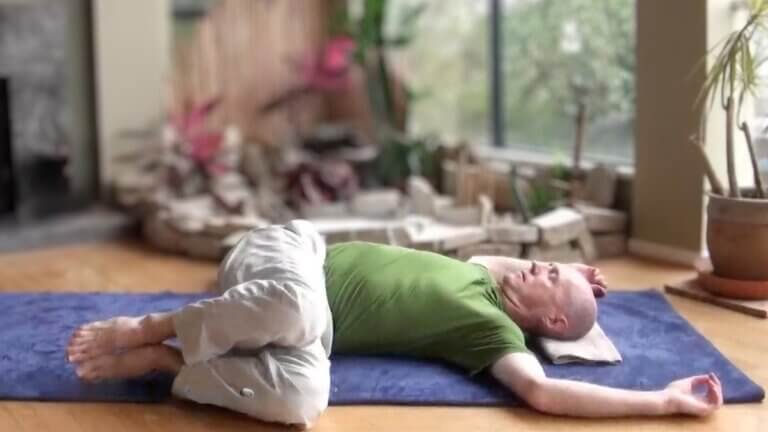
Reclining Twist Yin Yoga Pose: A Gentle Spine Release Guide
Reclining Twist Yin Yoga Pose: A Gentle Spine Release Guide
Reclining Twist Pose is a gentle Yin Yoga pose that supports the spine, hips, ribs, and lower back. It is practiced lying down with relaxed effort; it can help release tension through the back body, encourage easier breathing, and bring a quiet finish to your practice.
Reclining Twist Pose targets the spine, lower back, outer hips, ribs, chest, and abdomen.
Reclining Twist Pose: Overview
Yin Yoga’s Reclining Twist Pose is a supine twisting posture in which you lie on your back and let your knees fall to one side while your upper body stays open.
This pose is also known as the Supine Spinal Twist. In Sanskrit, you may see it referred to as Supta Matsyendrasana or Jathara Parivartanasana, depending on the Yoga tradition and the specific variation.
In Yin Yoga, Reclining Twist is usually practiced slowly and with support. Rather than using muscular effort to twist deeply, you allow gravity, time, and breath to soften the body into the shape.
The pose mainly targets the spine, lower back, outer hips, ribs, chest, and abdomen. It often fits well near the end of a Yin Yoga sequence, especially after hip openers, forward folds, or backbends.
A common variation is Twisted Roots Pose, in which the knees are crossed as in Eagle Pose (Garudasana). Crossing the knees creates a stronger stretch through the outer hips, glutes, and lower back.
How to Do Reclining Twist Pose in Yin Yoga
In Yin Yoga, the goal is not to force the biggest twist. Choose a version where your spine can soften, your breath can stay easy, and your shoulders do not have to fight the floor.
Benefits of Reclining Twist Pose
Reclining Twist Pose is one of the most useful end-of-practice shapes in Yoga because it combines spinal rotation, lower-back release, and a quiet, reclined position.
Physical Benefits
Energetic Aspects: Chakras & Meridians
In Yin Yoga, the Reclining Twist Pose is often associated with the Urinary Bladder meridian because of the release through the back body and spine. Depending on the variation, it may also affect the Gallbladder meridian along the outer hips and the sides of the body.
Energetically, twists are often used to create a sense of clearing, spaciousness, and balance. Reclining Twist can feel grounding because the floor fully supports the body, while the rotation through the spine offers a gentle sense of unwinding.
On the chakra level, this pose may be connected with the Root Chakra through its grounding quality and the Solar Plexus Chakra through the rotation of the abdomen and the center of the body.
As always, energetic effects are personal. Some students experience the Reclining Twist as a deep release, while others experience it as a comfortable way to rest the back and hips.
Contraindications & Safety
Reclining Twist Pose is generally gentle, but it still needs to be adapted to the body practicing it.
Modify or avoid this pose if you have:
Acute lower-back pain: Use support under the knees or choose a smaller twist. If twisting increases pain, come out of the pose.Disc issues or nerve symptoms: Avoid forcing the twist, especially if you feel numbness, tingling, or shooting sensations down the leg.Pregnancy: Deep closed twists are usually avoided during pregnancy. A supported open twist or side-lying rest may be more appropriate.Recent abdominal surgery: Wait until you are cleared to resume twisting movements, and avoid any position that causes pressure or discomfort.Shoulder discomfort: If the top shoulder cannot rest comfortably, place a folded blanket under it or bring the arm closer to the body.Hip or sacroiliac sensitivity: Keep the knees supported and avoid letting the top leg hang unsupported.
A good rule for this pose: support the knees before the lower back starts to complain. You should feel a gentle twist, not strain through the spine, hips, or sacroiliac joint.
Pose Modifications & Variations
Reclining Twist Pose is easy to adjust with props, making it useful for practitioners at many levels.
Supported Reclining Twist Pose
Place a bolster, folded blanket, or block under the knees after they fall to one side. This reduces the intensity of the twist and helps the lower back relax.
This is often the best version for beginners, students with tight hips, or anyone practicing near the end of class.
Reclining Twist Pose with Props
A bolster between or under the knees can make the pose feel more grounded and less demanding.
You can also place a folded blanket under the top shoulder if it floats far from the floor, or under the head if the neck feels strained.
A sandbag or two on the shoulder or knees can deepen and ground the pose.
If the lower back feels pulled, bring the knees closer to the chest or move them away until the twist feels more balanced.
Read 8 Yoga Props That Support Your Yin Practice to learn more.
Sandbags help to ground Reclining Twist Pose
Beginner-Friendly Variation
Keep both knees bent and feet on the floor before dropping the knees to one side. This creates a smaller twist than drawing the knees all the way into the chest.
You can also keep a pillow or bolster under the knees so the legs are fully supported.
Another option is to twist with one knee bent and the other leg extended. This can reduce pressure in the hips and lower back.
Reclining Twist with one knee bent and the other leg extended.
Deeper Variation
For a stronger variation, draw the knees higher toward the chest before letting them fall to one side. Drawing the knees tighter usually increases the rotation through the lower back and outer hip.
You can also practice Twisted Roots Pose, a variation of Reclining Twist, where you cross the legs ar as they are in Eagle Pose, or Garudasana. After crossing the knees, drop the legs to one side to deepen the stretch in the outer hips, glutes, and lower back.
For Yin Yoga, deeper is not automatically better. If the twist becomes sharp, pinchy, or difficult to breathe in, return to a simpler supported version.
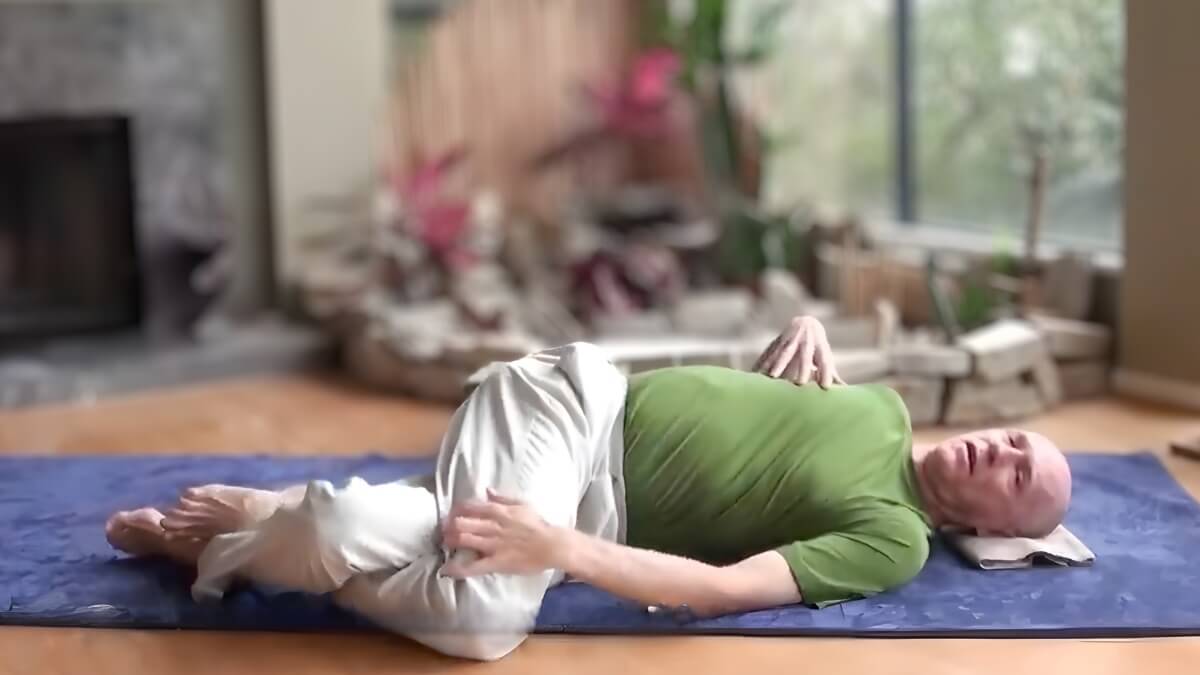
Muscles, Joints & Target Areas
Reclining Twist Pose mainly works through the spine, hips, ribs, and lower back.
Primary target areas:
Lower backSpineOuter hipsGlutesRibs and side bodyChest and shoulders
Common anatomical focus:
Lumbar spineThoracic spineSacroiliac areaGluteal musclesPiriformis and deep hip rotatorsObliquesIntercostal musclesShoulder girdle
In Yin Yoga, the longer hold gives the body time to gradually settle into the twist. The emphasis is not on using force to rotate the spine, but on finding a supported position where the tissues around the back, hips, and ribs can soften slowly.
Beginner Tips for Practicing Reclining Twist Pose
Start small. A mild twist held comfortably is usually more useful than a deep twist held with tension.
Support your knees with a bolster or blanket if they do not rest easily.Keep your breath natural. If breathing feels restricted, reduce the twist.Let the shoulders be relaxed, even if one shoulder does not touch the floor.Move slowly when switching sides. After several minutes, the back and hips may feel sensitive for a moment.Avoid pushing the top knee down with your hand. Let gravity and support do the work.
Reclining Twist should feel steady, spacious, and manageable. If you feel sharp pain, numbness, tingling, or strain, come out and adjust the setup.
How Long Should You Hold Reclining Twist Pose?
In a Yin Yoga practice, Reclining Twist Pose is commonly held for 3 to 5 minutes per side.
Beginners can start with 1 to 2 minutes per side, especially if the lower back, hips, or ribs feel sensitive.
More experienced students may stay longer, but only if the pose remains comfortable and the breath stays easy. Longer holds are not necessary if the body is already giving clear feedback.
Use a timer so you can settle into the pose without checking the clock.
When to Practice Reclining Twist Pose
Reclining Twist Pose works especially well near the end of a Yin Yoga practice.
Use it after hip openers such as Butterfly, Dragon, Sleeping Swan, or Happy Baby to help release the lower back and outer hips.
After backbends such as Sphinx, Seal, or Saddle, bring the spine into a gentler, more neutral position.
Use it before Savasana to settle the nervous system and finish with a quieter shape.
It can also be practiced on its own when your lower back feels tight, and you want a simple reclined pose.
Counterposes for Reclining Twist Pose
After the Reclining Twist Pose, give your body a neutral pause before moving on.
Good counterposes include:
Knees to Chest: Hug your knees in and let the lower back settle.Constructive Rest: Place your feet on the floor, knees bent, and let the knees fall toward each other.Savasana: Extend your legs and rest quietly for a few breaths.Windshield Wipers: With your feet on the floor, slowly move your knees from side to side to gently reintroduce movement into your hips and lower back.
Stay in your counterpose for at least 30 seconds up to 1 minute before continuing.
Related Yin Yoga Poses
If you enjoy the Reclining Twist Pose, these related poses may also be useful:
Happy Baby Pose: A reclined hip opener that works well before or after a gentle twist.Butterfly Pose: A seated forward fold that targets the inner thighs, groin, and lower back.Sleeping Swan: A deeper hip-opening pose that targets the outer hips and glutes.Sphinx Pose: A gentle backbend that pairs well with Reclining Twist as a counterpose.Child’s Pose: A grounding forward fold that can help settle the back after twisting.
These poses can be linked together for a simple Yin Yoga sequence focused on the hips, spine, and lower back.
Reclining Twist Pose FAQ
What is Reclining Twist Pose in Yin Yoga?
Reclining Twist Pose is a supine spinal twist practiced lying on the back. The knees fall to one side while the upper body remains open. In Yin Yoga, the pose is held quietly for several minutes to target the spine, lower back, hips, ribs, and sides of the body.
What are the benefits of Reclining Twist Pose?
Reclining Twist Pose can help release the lower back, support spinal mobility, stretch the outer hips, open the ribs, and encourage relaxation. In Yin Yoga, it is also commonly associated with the Urinary Bladder meridian and, depending on the variation, the Gallbladder meridian.
How long should you hold Reclining Twist Pose?
Most students can hold the Reclining Twist Pose for 3 to 5 minutes per side in a Yin Yoga practice. Beginners may prefer 1 to 2 minutes per side at first. Come out earlier if you feel sharp pain, numbness, tingling, or strain in the back, hips, or shoulders.
Is Reclining Twist Pose safe for beginners?
Yes, the Reclining Twist Pose can be beginner-friendly when it is supported. Use a bolster or folded blanket under the knees, keep the twist mild, and avoid forcing the legs toward the floor. The pose should feel steady and manageable, not aggressive.
What should I do if Reclining Twist Pose feels uncomfortable?
First, reduce the twist. Bring the knees closer to the centre, support them with a bolster, or place a blanket under the top shoulder. If the discomfort feels sharp, pinchy, nervy, or increases as you stay, come out of the pose and choose a gentler variation.
Reclining Twist Pose is a simple way to bring the spine, hips, and lower back into a quieter relationship with gravity. Instead of forcing the twist, let the floor and your props support you. With patience, the pose can become a steady place to soften, breathe, and settle before rest.
Practice Yin Yoga with us
Join Bernie Clark and Diana Batts for their weekly live online Yin Yoga Classes, or practice with their recordings. Available in the Welcome to the Yinside Subscription.
Kevin Parenteau
He is a long-time Ashtanga and Yin Yoga Practitioner. Vipassana Meditator, Yoga teacher,
and all-around Yoga Nerd.
Writes on Yoga Asana Practice, Meditation, Chakras, Yoga Education, and Philosophy
You Love Yoga, We Love Yoga—Let’s Stay Connected
Get yoga tips, a little inspiration, and friendly emails—because yoga is better with friends.
No spam. No selling your data. Ever.
The post Reclining Twist Yin Yoga Pose: A Gentle Spine Release Guide Written By Kevin Parenteau appeared first on Asana at Home Online Yoga Inc..
Leave a Reply Cancel reply
Recent Comments
Archives
- September 2026
- August 2026
- July 2026
- June 2026
- May 2026
- April 2026
- March 2026
- February 2026
- January 2026
- December 2025
- November 2025
- October 2025
- September 2025
- August 2025
- July 2025
- June 2025
- May 2025
- April 2025
- March 2025
- February 2025
- January 2025
- December 2024
- November 2024
- October 2024
- September 2024
- August 2024
- July 2024
- June 2024
- May 2024
- April 2024
- March 2024
- February 2024
- January 2024
- December 2023
- November 2023
- October 2023
- September 2023
- August 2023
- July 2023
- May 2023
- March 2023
- February 2023
- August 2022
- July 2022
- June 2022
- May 2022
- April 2022
- March 2022
- February 2022
- January 2022
- December 2021
- November 2021
- October 2021
- September 2021
- August 2021
- July 2021
- June 2021
- May 2021
- April 2021
- March 2021
- February 2020
- January 2020
Theme by The WP Club . Proudly powered by WordPress